Why This Matters
Many businesses believe they have systems. In reality, they often have experienced people who know how things work.
That distinction matters. When critical knowledge exists only in people’s heads, the business becomes dependent on memory, judgement and informal routines rather than documented processes.
That risk often remains hidden while the same people remain in the same roles. It becomes visible when staff leave, responsibilities change, systems evolve or management tries to automate a workflow that has never been clearly documented.
For growing businesses, process clarity is no longer just an audit or compliance issue. It is a management issue, a governance issue and increasingly an automation issue.
Before a business can safely automate a process, it needs to understand how that process works, who performs each step, what approvals are required, how exceptions are handled and what evidence is retained.
"The businesses most likely to benefit from AI and automation will not necessarily be those with the newest technology. They will be the businesses with the clearest processes."
When Knowledge Lives in People's Heads
In many small and medium-sized businesses, critical knowledge exists almost entirely in people’s heads.
The accounts payable officer knows which invoices need approval. The payroll manager knows which exceptions require special treatment. The office manager understands which supplier issues need escalation.
The process exists. It just isn't written down.
That usually isn't a problem until something changes.
People retire. People resign. People are promoted. People take leave. People move on.
Suddenly the business discovers that what appeared to be a system was actually institutional knowledge. The process existed because one person knew how it worked.
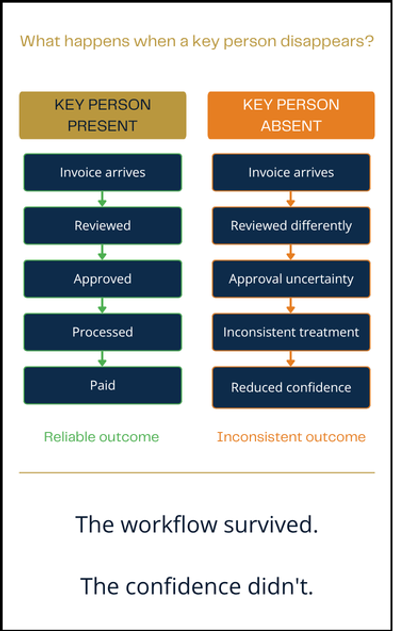
The distinction is easier to see visually.

"The businesses that operate most effectively are rarely the ones with the smartest people. They are the businesses where everyone understands how things are supposed to happen."
When the System Is Actually a Person
A business does not have a reliable process if it only works while one particular person is available.
"A resilient business is one where knowledge belongs to the organisation—not just to the people within it."
Most businesses continue to operate successfully because experienced people quietly compensate for undocumented processes. They remember exceptions, know who to ask, recognise unusual situations and make the adjustments that keep work moving.
That hidden expertise is incredibly valuable—but it also creates dependence. The business gradually becomes reliant on individuals rather than on clearly documented ways of working.
The weakness often remains invisible until someone is unavailable. At that point the organisation discovers that what appeared to be a reliable system was actually the experience and judgement of one person.
The difference becomes obvious when the key person is no longer available.
What Auditors Look For
Reliable outcomes do not come from reliable people. They come from reliable processes.
Audit is often misunderstood as the testing of transactions. In reality, auditors spend much of their time assessing whether an organisation can consistently produce reliable outcomes.
The question is rarely whether a particular employee performed a task correctly. The question is whether the process itself would produce the same result tomorrow, next month or after a change in personnel.
This is why auditors focus on how work is initiated, reviewed, approved, documented and evidenced.
These are not simply audit questions. They are management questions and, increasingly, they are automation questions.
These questions quickly reveal whether a process is truly reliable.
"When the process is unclear, outcomes become dependent on individual judgement, experience and memory."

Growth Creates Complexity & Risk
Growth rarely creates problems. Growth exposes the problems that were already there.
In a small business, undocumented knowledge is often manageable. Team members work closely together, informal conversations fill the gaps, and experienced staff naturally compensate for missing documentation.
As the business grows, that approach becomes increasingly difficult to sustain. More staff, more customers, more transactions and more systems introduce complexity that informal knowledge can no longer support.
The challenge is not simply one of scale. It is one of consistency. Every additional person, process or location increases the need for clearly defined responsibilities, documented workflows and reliable controls.
As complexity increases, the gap between informal knowledge and documented systems becomes much easier to see.
"Growth doesn't remove the need for good systems. It makes them indispensable."

Why This Matters Before You Automate
AI does not replace the need for good processes. It amplifies the value of having them.
Businesses are increasingly looking to AI and automation to improve efficiency, reduce manual effort and support growth. Those objectives are achievable—but only when the underlying processes are clearly understood.
Automating an undocumented process does not eliminate inconsistency. It allows inconsistency to occur faster and at greater scale. Before a workflow can be automated, the business needs confidence that each step, decision and approval has been deliberately designed.
Organisations that have invested in governance, documentation and process discipline are not starting from scratch. They have already created the foundation that allows AI to deliver consistent, reliable outcomes.
Automation succeeds when processes are understood before they are automated.
"The question is no longer whether businesses will adopt AI. The question is whether their processes are ready for it."

The Lewis Finlay Perspective
Technology is rarely the difficult part. Building reliable, repeatable business processes is where the real work begins.
One of the unexpected lessons from developing our own AI Governance Framework was that the technology was rarely the difficult part.
The real work was documenting processes, defining decision points and understanding how changes in one workflow affected policies, procedures and internal controls elsewhere in the business.
That experience reinforced something we had already observed through years of audit, advisory and commercial leadership: organisations that understand their own processes are significantly better positioned to improve them, govern them and automate them with confidence.
Whether the objective is stronger governance, better operational performance or successful adoption of AI, the starting point is remarkably consistent—understand how the business works before trying to change it.
"Businesses don't become more resilient because they adopt better technology. They become more resilient because they build better systems."