
The Project Started With Automation
When people ask me about AI and automation, the conversation usually starts with software.
Which platform are you using? Can AI automate this process? How quickly can we implement it?
They're reasonable questions. They're just not the questions that have taught us the most.
We began building an Accounts Payable Agent to automate a specific business process. On paper, it seemed relatively simple. The workflow was clear, the objective was clear and the technology was available. Within a relatively short period, we had a working solution.
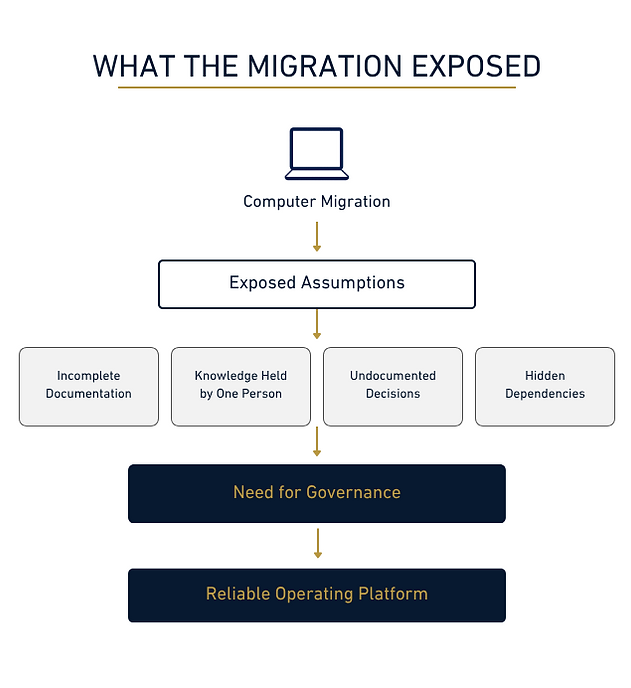
The turning point came when I migrated our development environment onto a new computer as part of a broader upgrade to Microsoft 365, improved security controls and a more structured operating environment. What I expected to be an administrative exercise became one of the most valuable governance exercises we've undertaken.
The migration exposed assumptions we didn't realise we were carrying. Some documentation was incomplete, some knowledge existed only because I remembered it, some decisions had never been documented and some dependencies were obvious to me but nowhere else.
Nothing was seriously broken. The platform simply wasn't yet capable of standing on its own.
That was the moment I realised we weren't actually building an AI platform. We were building an operating platform.
"The difficult part wasn't the technology. It was developing the discipline to understand, document and govern how the business actually works."
The Governance Realisation
What looked like a documentation problem quickly became a governance problem.
"We weren't building an AI platform. We were building an operating platform."
Looking back, that wasn't a diversion from the project. It was the project.
At first, I thought we had simply uncovered gaps in our documentation. The more we worked through the issues, the more we realised the questions weren't really about documentation at all.
They were governance questions. How do we keep documents current? Who approves changes? How do we know everyone is working from the latest version? How do we understand the impact that one change has on every related process, policy and control?
Those questions led us somewhere we hadn't expected. We found ourselves documenting decisions, defining responsibilities and building governance around our own work.
Controlled documents ensured everyone was working from the same source of truth. Structured revision management gave us confidence that changes could be traced and reviewed. Approval workflows introduced accountability before changes became operational.
Eventually, we built an AI Governance Agent to help manage that process. At first glance, it looked as though we had changed projects.
We hadn't.
We were simply building the foundations that made automation reliable.
Why Process Mapping Matters
Most businesses don't struggle to automate because they lack technology. They struggle because their processes exist in people's heads.
I suspect many businesses face exactly the same situation we uncovered.
The process probably works. The team knows what to do. Problems are solved quickly because experienced people understand the exceptions, the workarounds and the history behind the decisions.
The difficulty only becomes visible when something changes.
It might be a new employee. A new system. A restructure. A business acquisition. Or simply growth.
.
"The question isn't whether a process works today. The question is whether someone else could confidently operate it tomorrow."
Suddenly the business discovers that what looked like a process was actually a collection of assumptions, experience and individual judgement.
That's why process mapping isn't simply a documentation exercise.
It's a discovery exercise.
Before a workflow can be automated, someone has to understand it well enough to explain it to another person.
Only then can it be explained to a machine.
.

Before You Automate
Successful automation starts by understanding how the business works today before deciding how it should work tomorrow.
AI doesn't replace the need for good processes. In many cases, it simply amplifies the value of having them.
Businesses are increasingly looking to automation to improve efficiency, reduce manual effort and support growth. Those outcomes are achievable—but only when the underlying processes are clearly understood.
Automating an undocumented process doesn't eliminate inconsistency. It allows inconsistency to occur faster and at greater scale. Before a workflow can be automated, the business needs confidence that each step, decision and approval has been deliberately designed.
The organisations that achieve the most from automation are rarely the ones with the newest technology. They are usually the ones that understand their processes well enough to explain them, improve them and govern them.
Successful automation starts with understanding how the business works today before deciding how it should work tomorrow..
"The question is no longer whether businesses will adopt AI. The question is whether their processes are ready for it."
Before You Automate, Ask Two Questions
1. Could someone else confidently follow this process tomorrow?
2. Could we explain the process clearly enough for a machine to execute it?
.
If the answer to either question is no, there is usually process work to do before automation becomes reliable.
In our experience, that work often delivers benefits far beyond automation itself.
The Lewis Finlay Perspective
Process mapping is rarely about documenting what you already know. It's about discovering what the business doesn't yet understand.
Over the past several months, we've been building our own AI platform and automation capabilities within Lewis Finlay.
What began as a project to automate a single business process quickly became something much broader. It became an exercise in understanding how our own systems worked, documenting decisions, introducing governance and creating a platform capable of producing consistent and repeatable outcomes.
That experience reinforced something we have observed through years of audit, advisory and commercial leadership: organisations that understand their processes are significantly better positioned to improve them, govern them and automate them with confidence.
Whether the objective is stronger governance, better operational performance or successful adoption of AI, the starting point remains remarkably consistent—understand how the business works before trying to change it.
The businesses that achieve the greatest long-term value from automation are rarely the ones that move the fastest. They are usually the ones that build the strongest foundations first.
"Every successful automation project eventually becomes a process improvement project."